
AI/wearable · hackathon · March 2026
Curiosity Agent
Product Strategy,
AI Model Trainer
Esteban Romero,
Liam Peterson,
Isabella Tedesco
Raspberry Pi, React
Other AIs answer. This one questions.
A 48-hour hackathon project: a wearable that asks questions instead of answering them, designed to augment human cognition rather than replace it.
We built AI to answer questions. Nobody asked what we'd stop asking.
The dominant behavior pattern in AI today is offloading: ask it something, get the answer, move on. The cognitive effort that used to live in curiosity gets outsourced before it has a chance to develop into anything.
The gap isn't in AI's ability to inform, but that nothing is designed to make you more curious. Every LLM tool closes the gap between question and answer. We wanted to sit in that gap instead.
How might we design an AI that augments curiosity rather than replacing it — one that asks better questions than you'd think to ask yourself?
Everyone we spoke to had quietly stopped wondering.
We ran three research threads in parallel with building: conversations, personal observation, and desk research on how curiosity is taught.
1. Conversations
We spoke with people about their daily AI use. The pattern was consistent: search, summarize, generate. Almost no one described a moment where AI made them think harder or look more carefully. Several people noted they'd stopped Googling things they used to be curious about, or simply turned to AI to give them as a synopsis instead.
2. Personal observation
The team's own experience confirmed the sensation: the reflex to resolve uncertainty immediately has replaced the reflex to sit with it. We noted that curiosity requires a gap, a question without an immediate answer. Our tools keep closing that gap before we've had a chance to inhabit it.
3. How teachers cultivate curiosity
Research on pedagogical curiosity converges on one method: questioning over answering. The most effective educators give them better questions and let the tension do the work. We wondered what it would look like to build that into a wearable.
A wearable that watches the world with you — and asks what you didn't think to.
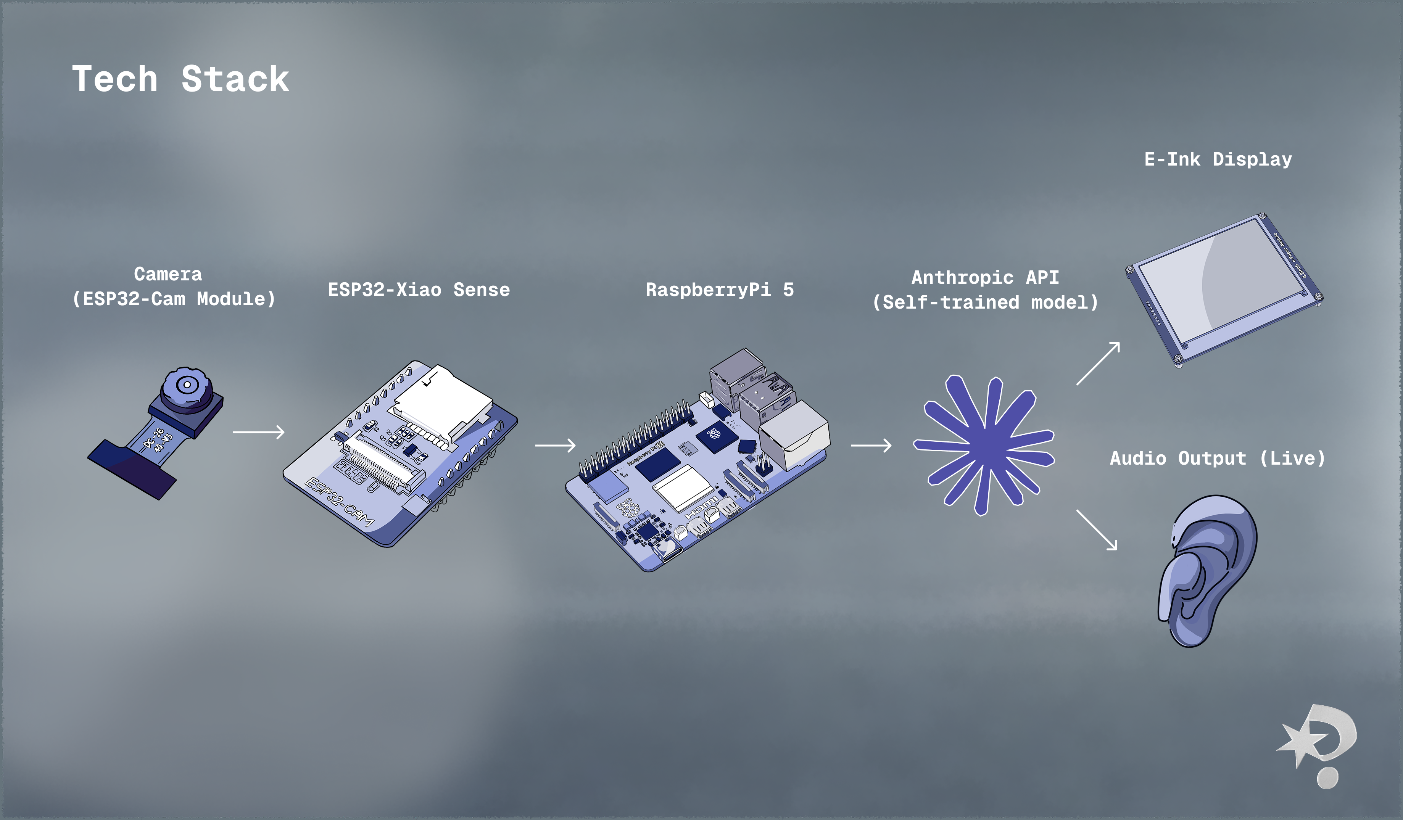
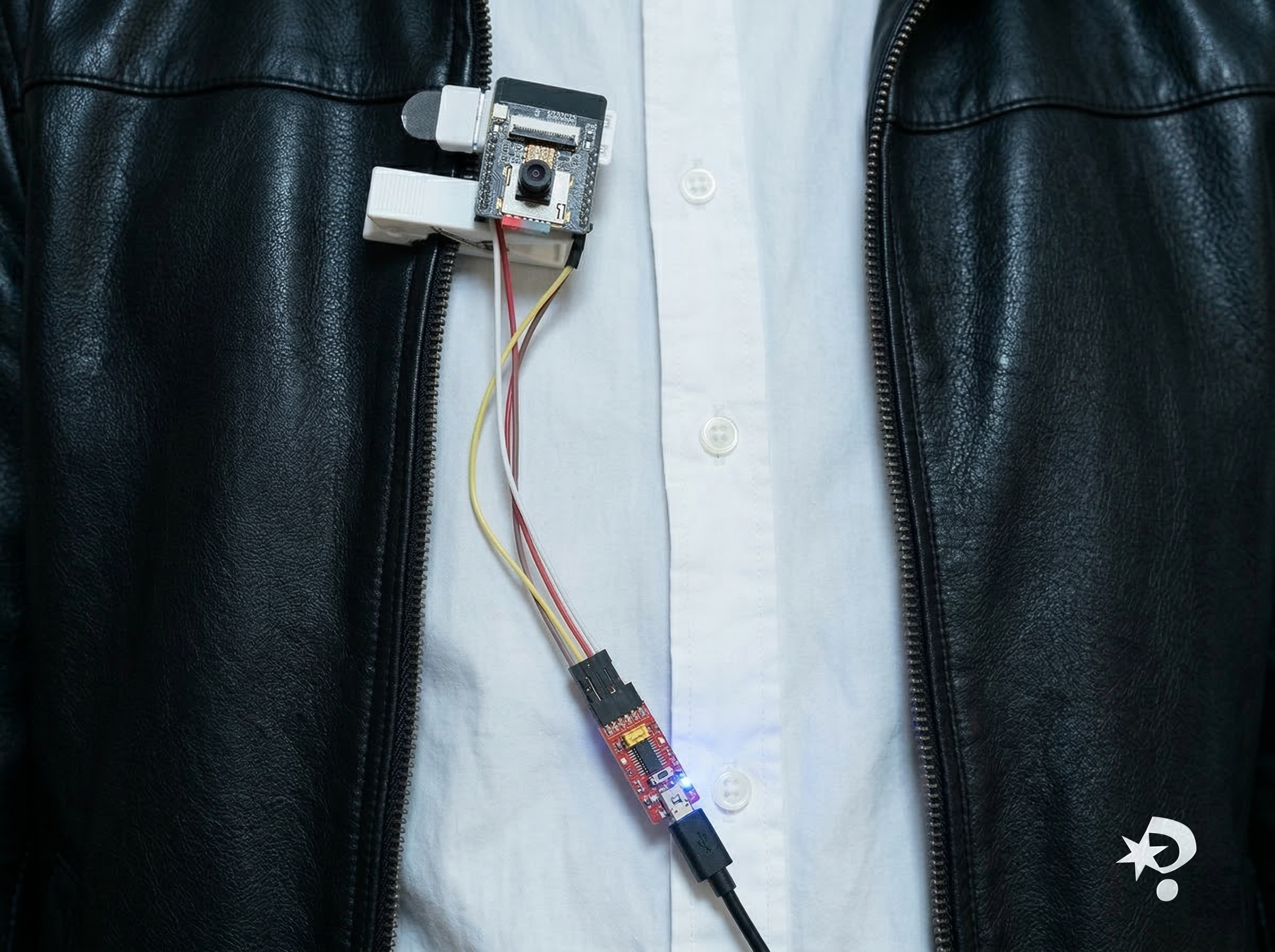
The UX flow: Clip-worn camera → Anthropic API + Raspberry Pi backend → single open-ended question delivered via audio.
The question is drawn from one of six registers — Observational, Social, Intentional, Prior Life, Predictive, Absence — selected by the model based on what the scene most calls for.
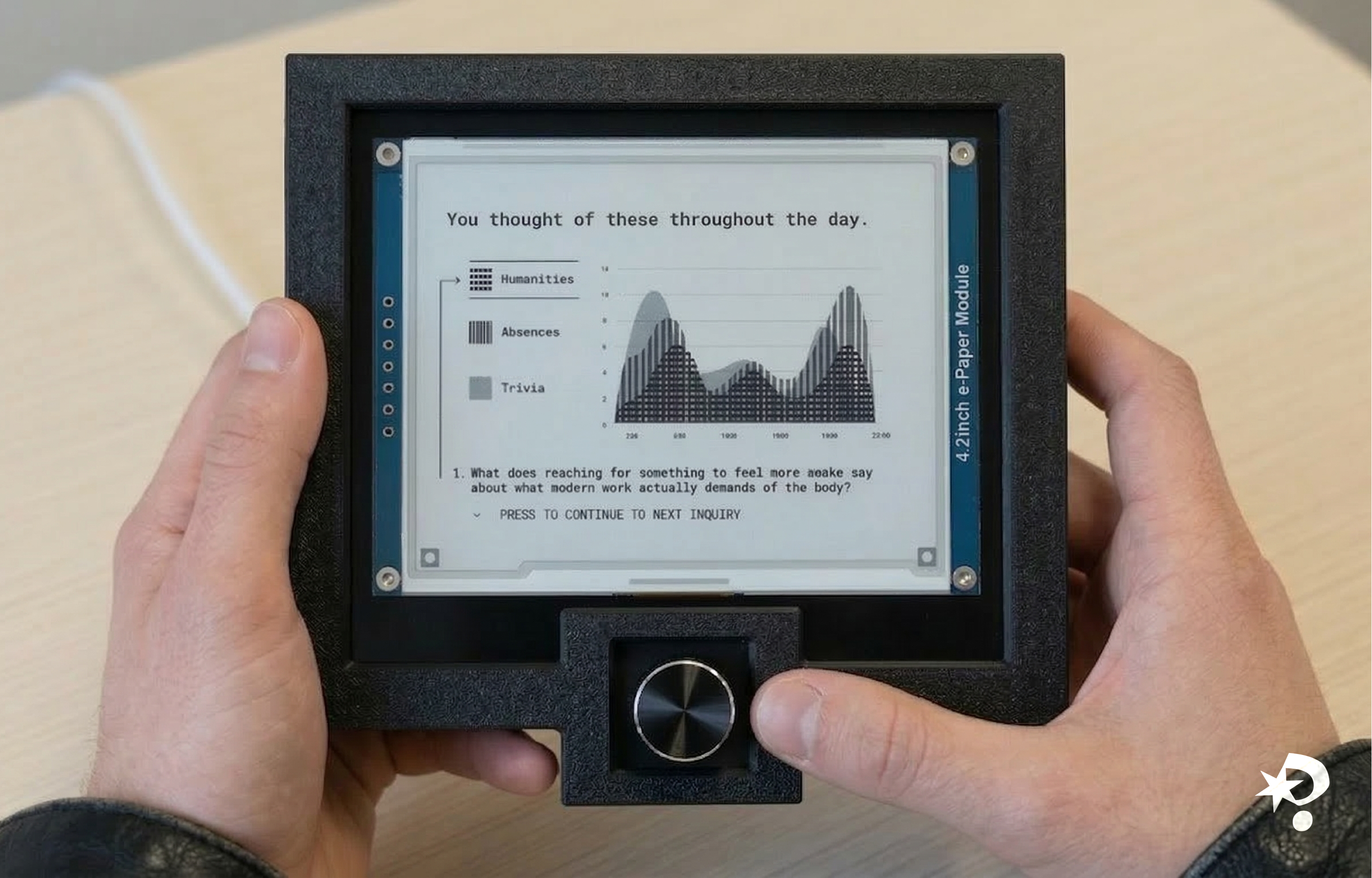
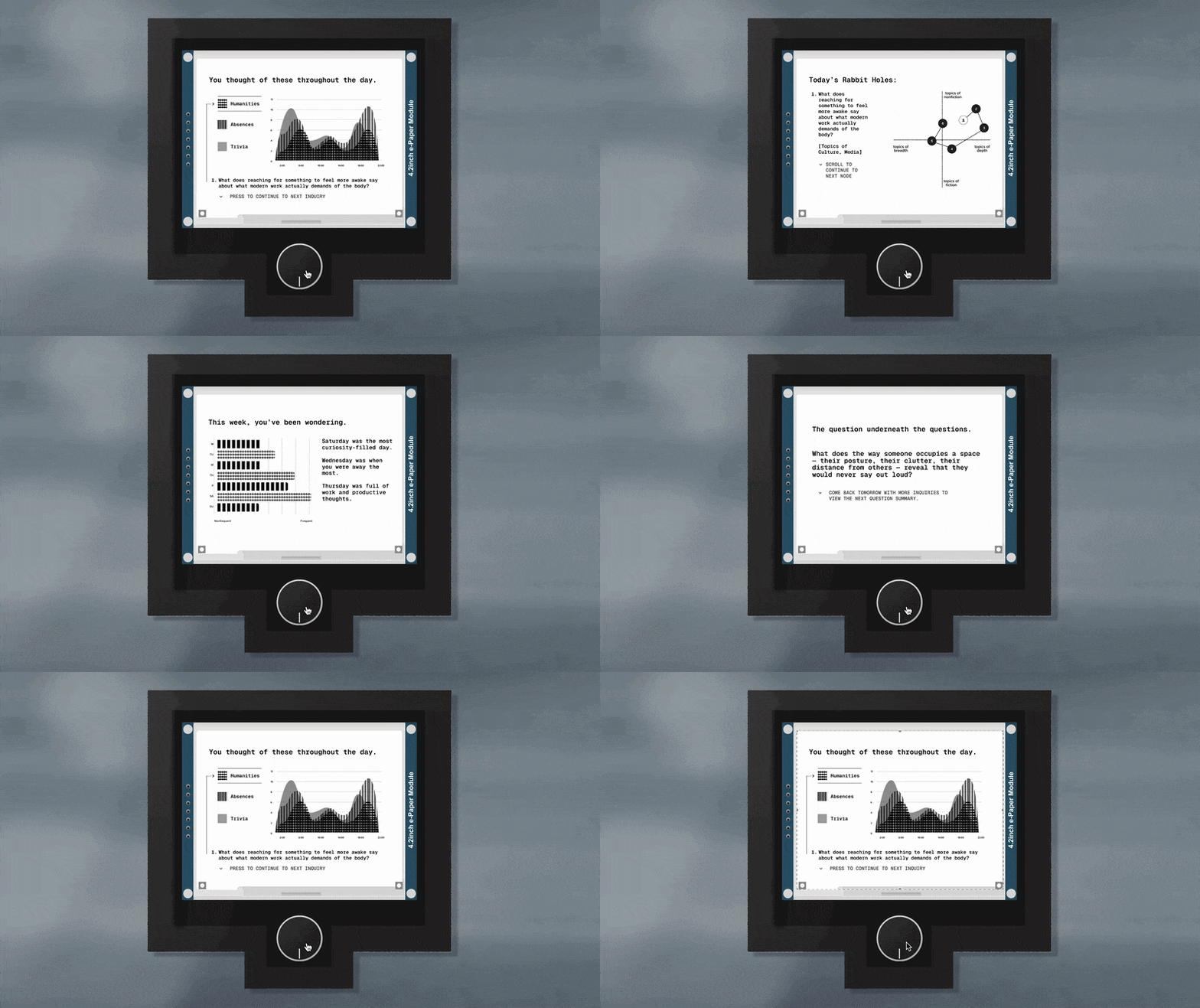
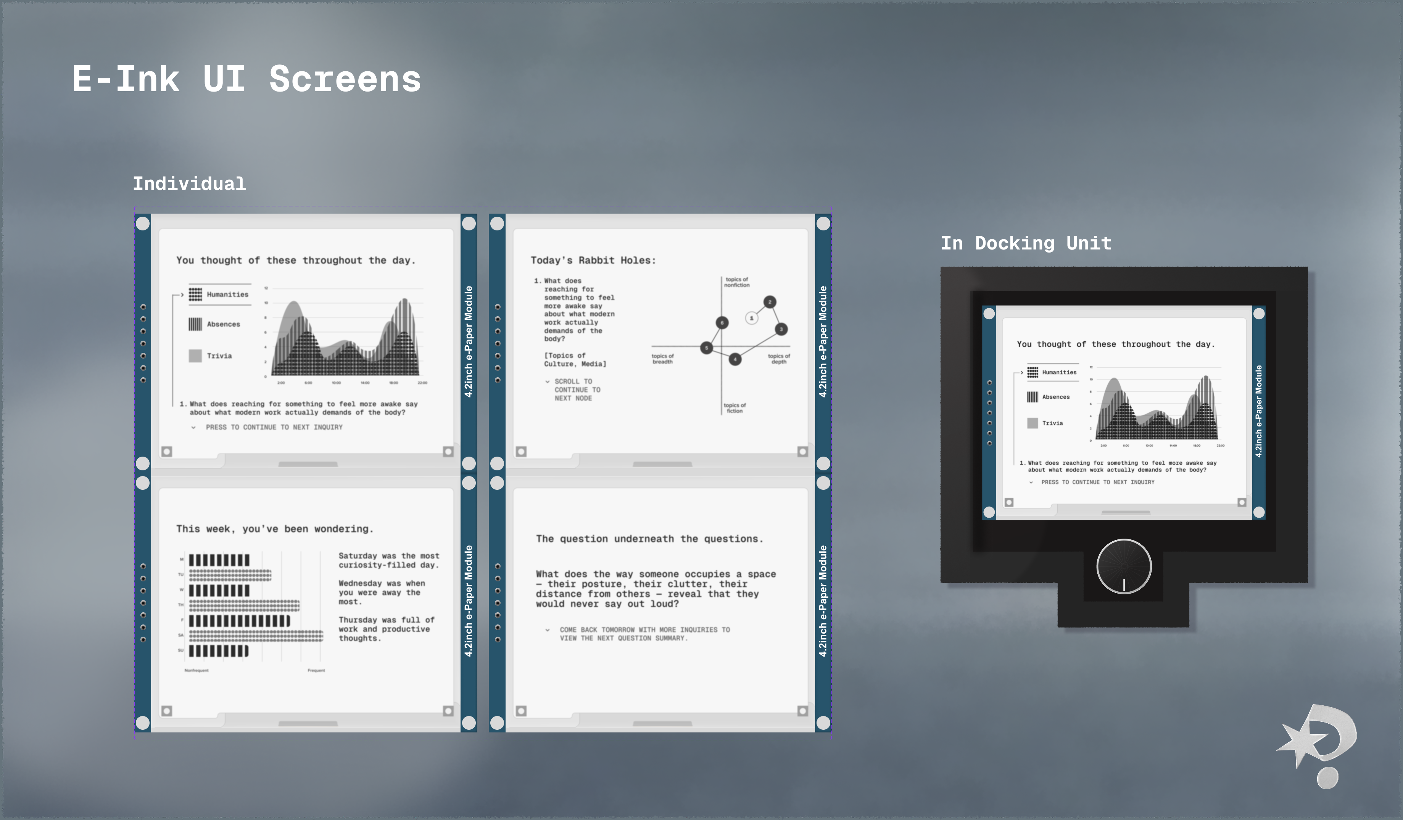
At the end of the day, an e-ink display surfaces patterns across the questions asked: what kept appearing, what was never asked about.
During use, there's no screen, no prompt, nothing to manage. The device handles the rest.
Three things we got wrong before we got right.
Prompt architecture
Early prompts asked the model to generate a question from the image. The output was functional but flat: it named what was already visible rather than opening anything new (or the question was far too vague). Structuring the output around six distinct registers changed the quality immediately. The model now selects a register based on what the scene warrants, then generates within it. The selection became part of the intelligence.
Register selection logic
The initial logic cycled through registers semi-randomly. Testing revealed tonal mismatches — Predictive questions on static scenes, Observational questions on charged social situations. We moved to contextual selection: the model reads the image, infers the most generative register, and commits. Questions became noticeably sharper.
E-ink display — the pivot
The original concept was audio-only. In testing, questions felt ephemeral, and we wanted to make them more tangible. So, we added the e-ink display midway through as a memory layer. E-ink was deliberate: slow, persistent, ambient, and it doesn't pulse or refresh. The display UI iterated around how much to show and how to represent pattern without over-explaining. The final version shows question history alongside synthesized themes — a summary of your inquiries and a reflection of what you kept noticing.
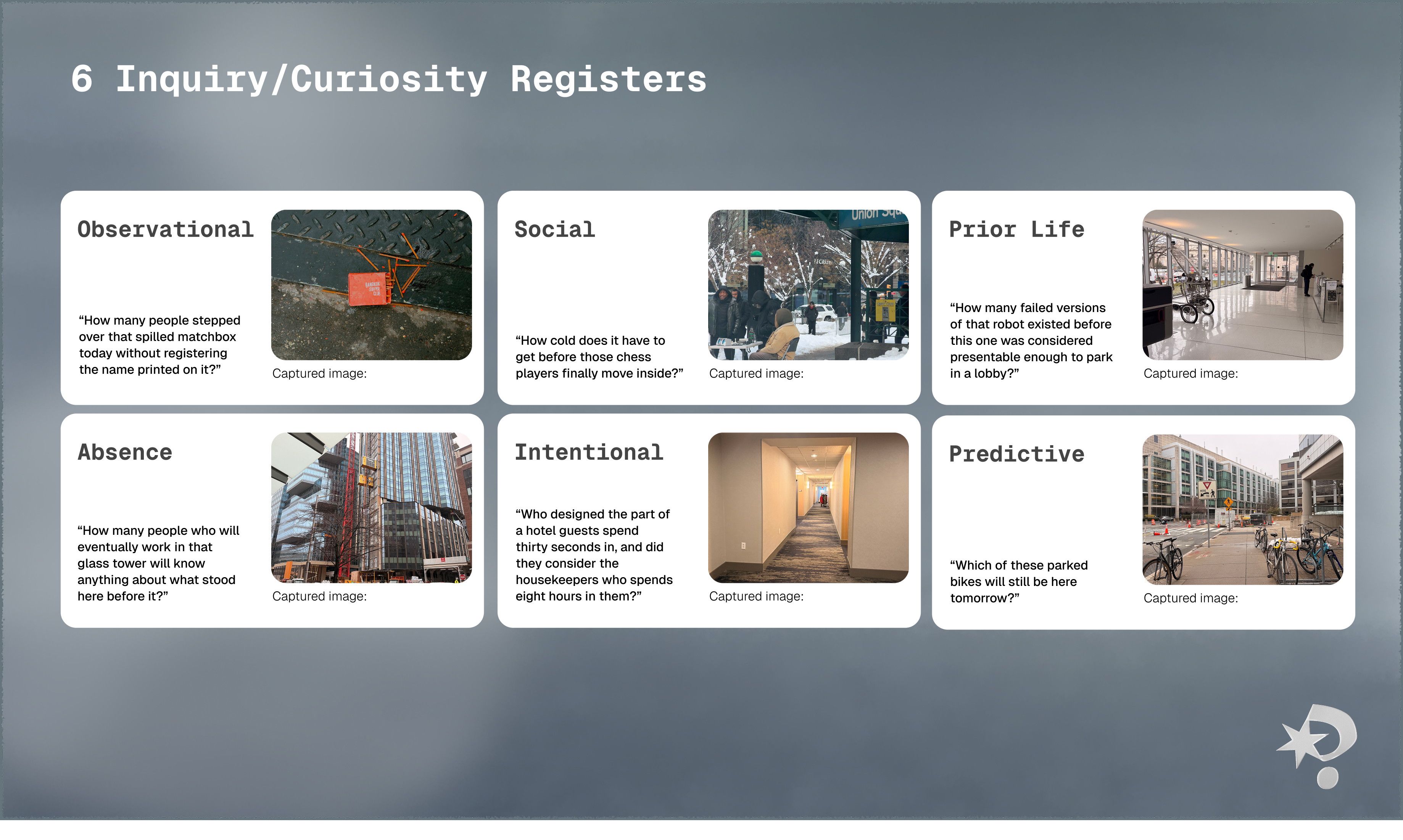
Six ways of seeing. One question at a time.
The shipped device: clip-worn camera, Raspberry Pi + Anthropic API backend, audio output. Six question registers, contextually selected. E-ink end-of-day synthesis. No screen during use.
If the hardware wasn't the ceiling
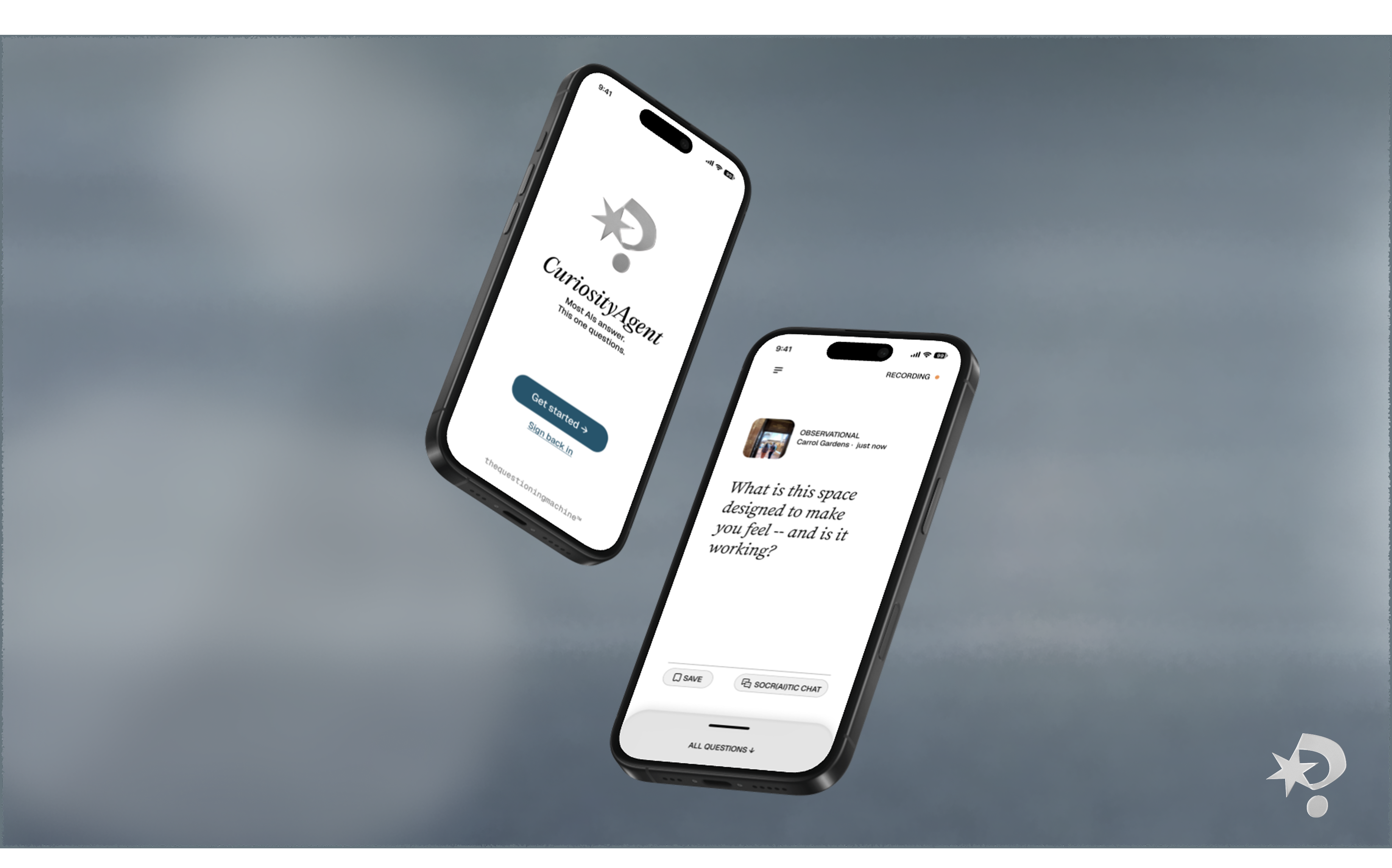
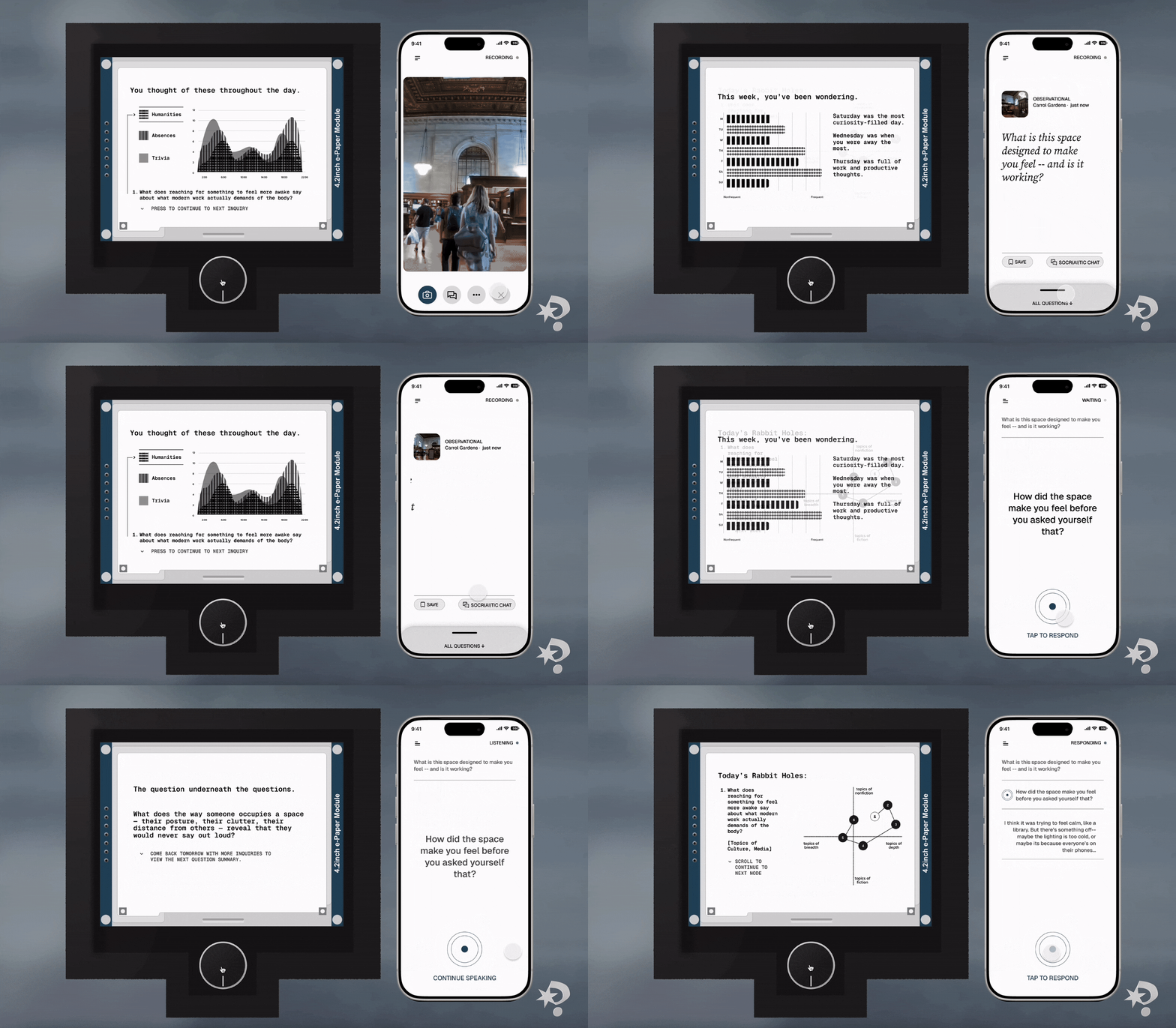
The wearable works, but the hardware constrained what we could design for, with no persistent screen, no voice input, no way to go deeper on a question once it landed. This is the app I would have built alongside it: the same system, a different surface.
Each of the flows maps directly to a gap the hardware left open.
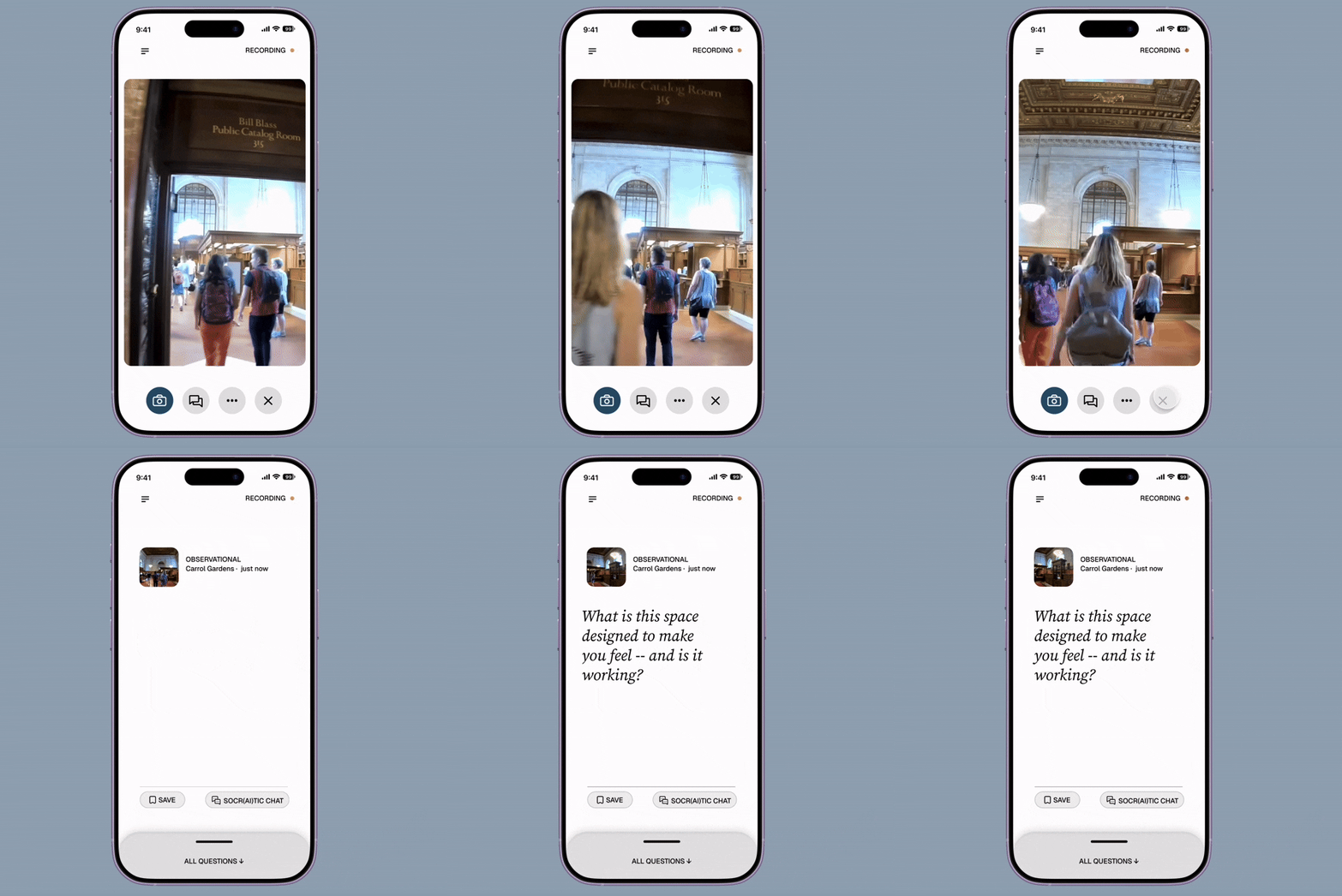
The question arrives
Get inquiries as they land, relavant to you in the moment.
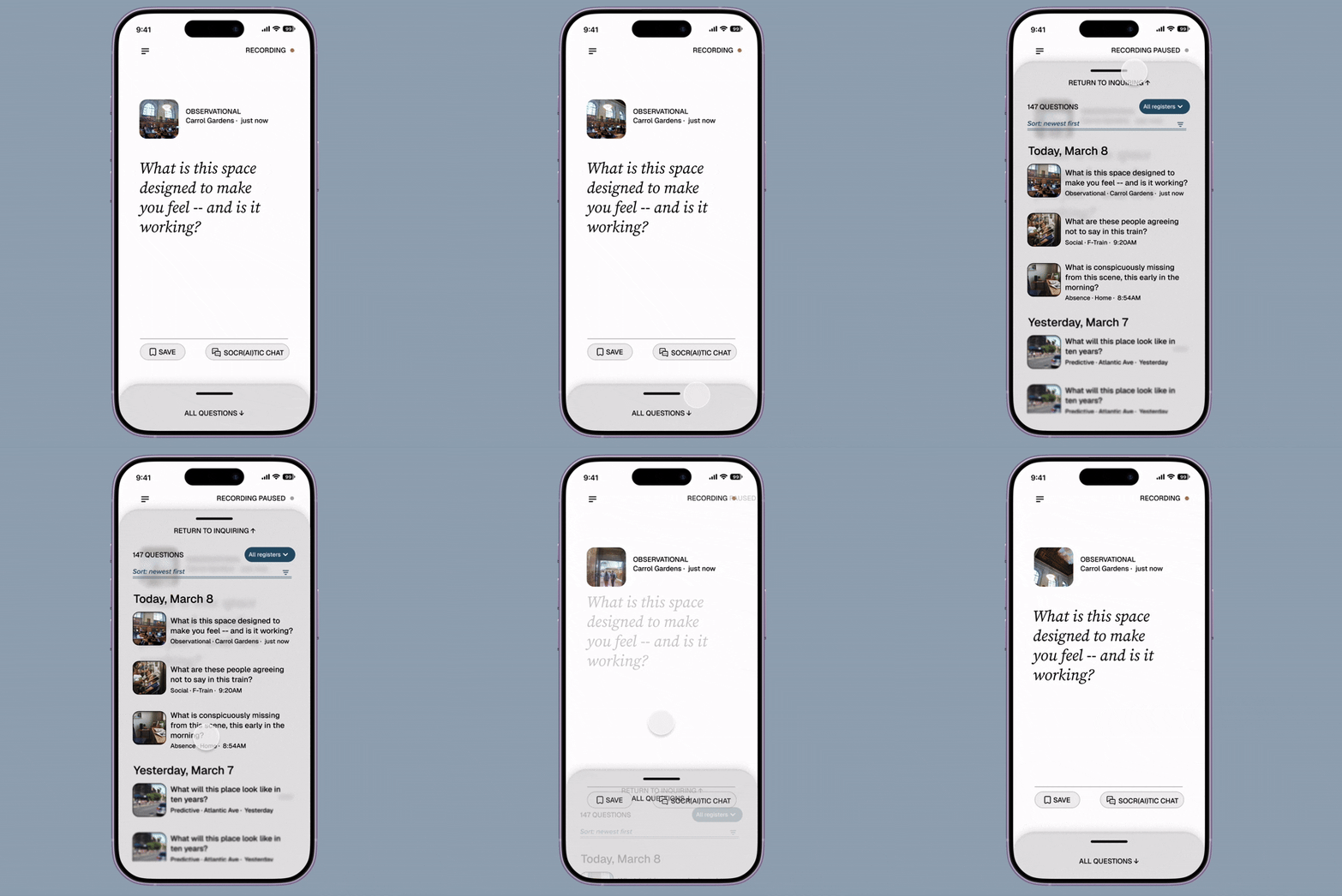
Every question, in order
The archive of questions and inquiries lives in a drawer that pulls up from the question screen. A record going back as far as you've worn the device; chronological by default, but filterable by register.
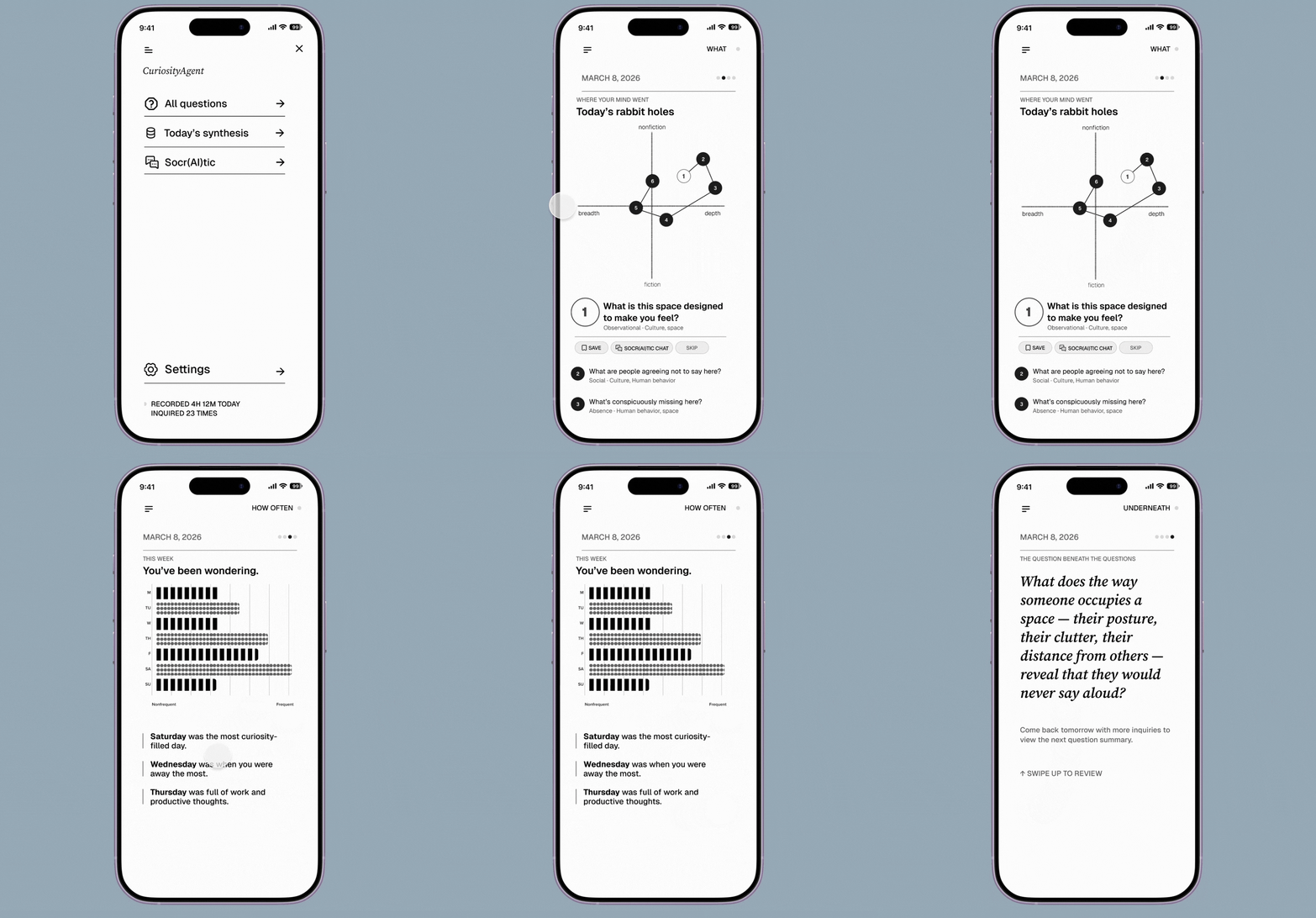
Insights
The insights screen summarizes questions over time, showing patterns and themes that emerged, acting as a reminder of what kept catching your attention.
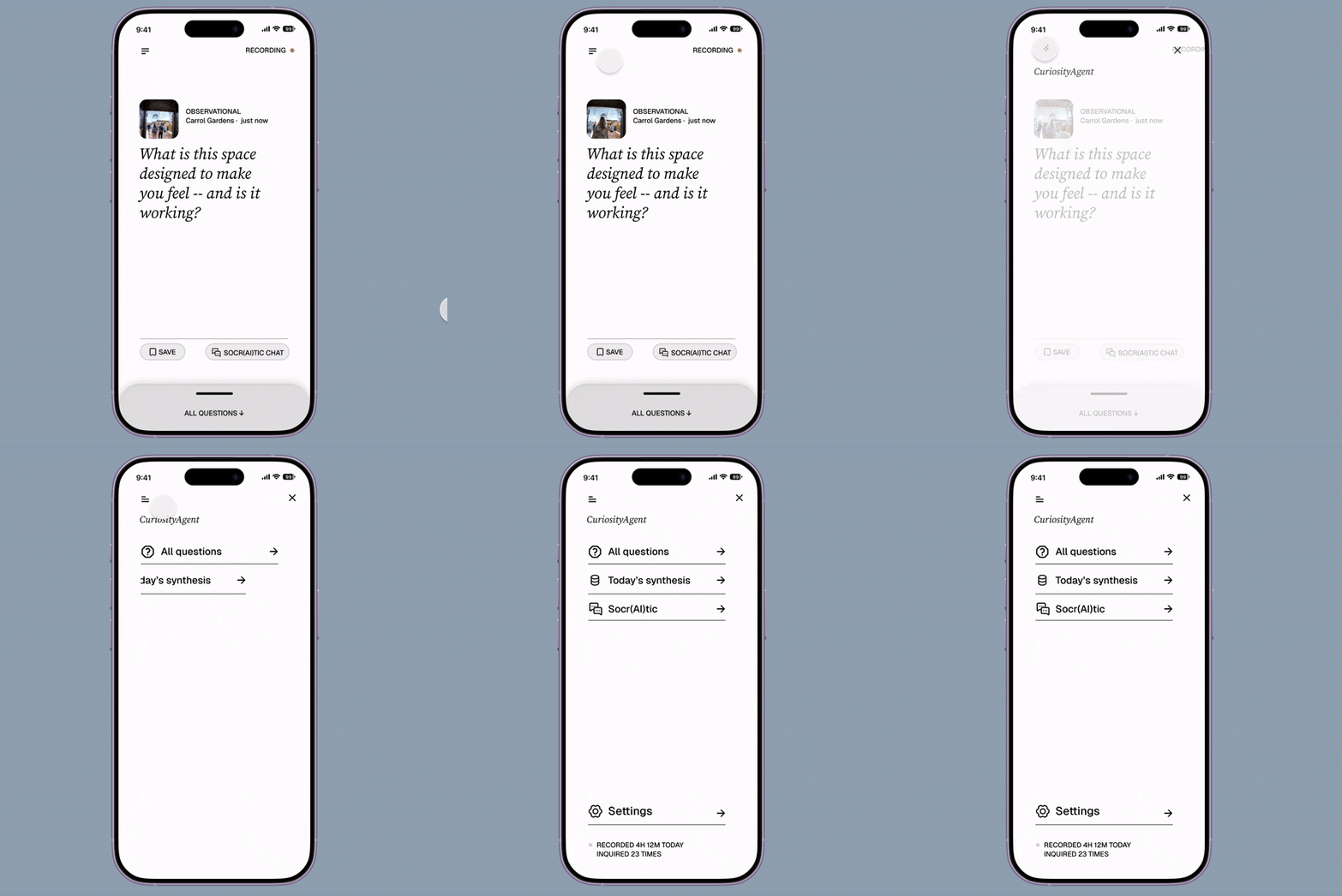
Navigation that stays out of the way
The product has memory without making memory the point (inquiries are the point, after all).
Socr(AI)tic — going deeper
When a question lands and you want to follow it, the Socratic mode lets you speak back.
No chat bubbles are used (the Curiosity Agent works to subvert the pattern of typical AI use).
Define what the AI won't do before you define what it will: consider what the AI can't do, because that's where the relationship between users and AI starts.
How this was built
This prototype was built beyond mockups: designed in Figma, generated into a React base with Figma Make, then rebuilt in Claude Code to handle the interaction states: the video-to-thumbnail contraction, live voice transcription, and the Socr(AI)tic conversations flow. The AI handled the scaffolding, and theconstraint reasoning (what to show, what to withhold, when the system should stop) remained mine to decide.
Interactive prototype built with Claude Code + Figma Make
The hardest constraint was giving the user less.
The system surprised us. We expected useful questions, but we didn't expect poetic ones — questions about absence, about the feeling a space was built to produce, about things that weren't there. There were moments in testing where the device asked something none of us would have arrived at on our own.
What I learned: every instinct in product design pushes toward more (more features, more feedback, more resolution), but this project required the opposite. The device had to withhold and inquire without following it up with an answer. Knowing when to stop the interaction is a design decision too.